Can we capture the logic of folklore in interactive, tactile form?
Reviving Culture is a design exploration on whether interactive, sensory engagement with folktales can keep cultural wisdom alive for a generation growing up on screens.
It is not a finished book. It is a prototype. A test to ask: does texture matter? Does interaction change how children connect with folklore? Can a story become more memorable when the child physically participates in it?
The question is how to make folklores and gallore of traditions and cultures feel alive again.
The question
Folklore once taught values through story. Now, for many children, it can feel distant, old, or boring because the elder generation either have forgotten their childhood magical stories or the older adults are no more around. Schools are increasingly digital. Nature is often taught as an abstract concept. Children do not touch things as much as they swipe through them.
01
Stories feel distant
Folklore is often treated as something old, moralistic, or separate from the child’s present world.
02
Learning is becoming flat
Digital learning gives access, but it often removes touch, slowness, and bodily engagement from the experience.
03
Nature feels abstract
Environmental values are often taught as facts, while older stories made care for nature emotional and lived.
04
Culture loses its medium
When storytelling disappears from homes, the wisdom carried by grandparents, elders, and local traditions weakens too.
Can the medium revive the message?
Folklore enabled in classroom practices for future leaders.
- Nature was sacred, not only a resource. Future leaders require to have empathy with nature in the same way as their own felt reality.
- Resourcefulness was admirable, not optional. Through stories values can be embibed into kids
- Stories taught values implicitly, not through lectures. made them feel more personal.
- Grandmothers’ stories carried memory, ethics, and ecological care. Without being standing up for causes, it was natural.
- If the stories disappear, the values hidden inside them may disappear too.
What we’re exploring
ONE STORY
A single folktale
Instead of trying to preserve many stories at once, the prototype begins with one folktale and studies how its key moments can become interactiveand thought provoking.
TACTILE FORM
Story + sensation
Each story moment is paired with a texture, action, or physical gesture: folding, tracing, touching, opening, or revealing, this might enable the kids to have a running conversation while having fun.
CHILDREN 6–12
Testing with readers
The project focuses on children old enough to follow narrative meaning, but young enough for imagination, touch, and play to shape memory.
Not gadgets. Just story plus sensation.
How the prototype works
01
Choose
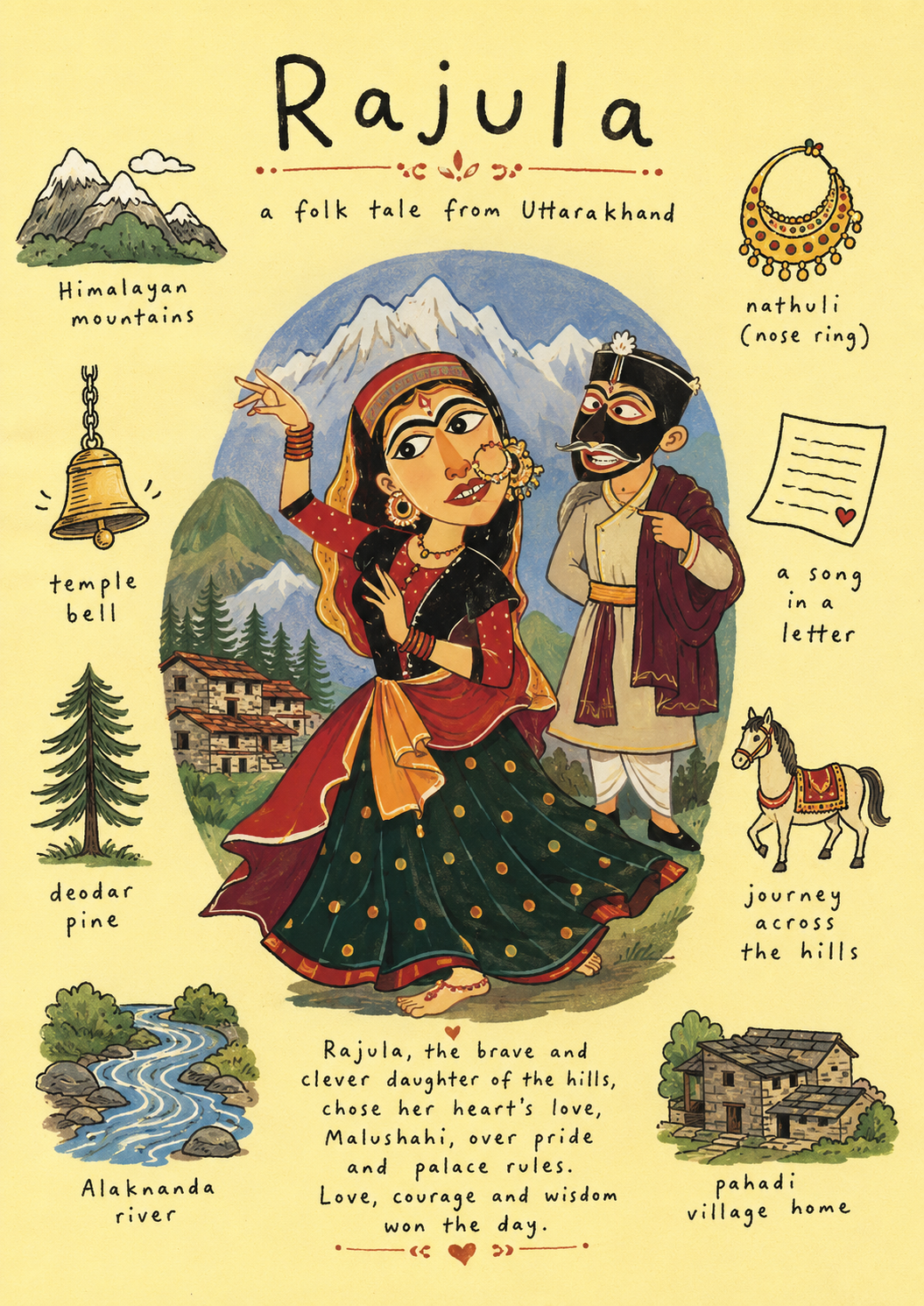
Select one traditional folktale carrying cultural, ethical, or environmental meaning (Story - Rajula and Malushai from the mountains of Uttarakhand).
02
Translate
Convert important story moments into tactile actions: touch, trace, fold, move, open, or reveal.
03
Observe
Test whether children respond differently when the story is not only read, but physically experienced.
What we’re testing
ENGAGEMENT
Do children engage differently?
Does a tactile folktale hold attention better than reading or listening alone?
MEMORY
Does texture create recall?
Does touching a river, tree, animal, or object help children remember the story’s lesson?
MEANING
Does interaction create meaning?
Does performing an action inside the story make the child feel more connected to the narrative?
RELEVANCE
Can folklore compete with screens?
If the medium shifts, can traditional stories feel playful, alive, and worth returning to?
The central concept for this phase of the study - kids and secondary stakeholders through artifacts on what works as a stimuli for remebering elements of the story. Composition, Exploration, interaction and color hues.
Rajula was a daughter of the hills.
Malushahi belonged to the palace.
Their worlds were not meant to meet.
But love travelled anyway.
Through rivers, forests, songs, and mountain roads.
Rajula chose her own heart.
Malushahi left behind pride, throne, and comfort.
The story remembers both of them,
because it crossed what society had already decided.
In this book, Rajula becomes a story of courage:
a child traces the river,
opens the letter,
touches the mountain,
and learns that love, memory, and belonging
often ask us to move.
Note: " This work began as my seminar project at IIT Roorkee as a Pilot study. As part of it, written consent for the video, audio recording and photography was taken from the parents of the kids along with the PI always present throughout the meetings and the recordings for the course of Design Seminar DEC-690 (DOD, IIT Roorkee)."
The hypothesis
HYPOTHESIS
Tactile storytelling sticks differently than reading alone.
Touch activates memory. Ritual creates ownership. If a child physically participates in a story, the story’s value may become easier to remember.
RELATED WORK
-
Maria Montessori’s work on sensory learning supports the idea that children learn through active engagement, not passive reception.
-
Daniel Siegel’s writing on child development connects narrative, emotion, and embodied experience as important parts of learning.
CONSTRAINTS
- This is a seminar project (pilot study), not a finished product.
- The sample size is small.
- The project does not validate folklore for all cultures or all age groups.
- The aim is narrower: to ask whether tactile design makes a difference.
If we’re right
Folklore becomes a design problem, not a nostalgia problem.
Cultural preservation becomes possible through interaction, not lecture. Children who may not want to hear a grandmother’s story might still want to touch it, open it, trace it, and move through it.
If interactive design can revive folklore, it revives something larger too: the idea that nature matters, culture matters, and stories carry more than entertainment.
CURRENT STAGE / WORK IN PROGRESS
This project is still unfolding.
The book artifacts are not final yet. The next stage is focused on collecting stories through conversations with grandmothers and older family members, so that the tactile pages are not designed only from visual references, but from lived memory, oral storytelling, and intergenerational knowledge.
I am also exploring how each story can move beyond printed illustration into texture, sound, touch, smell, and other sensory cues, while making sure the artifacts remain inclusive and accessible for different children.
A second stage of qualitative research is currently under process using mood cards as a participatory framework. The aim is to understand what kinds of story formats, sensory moments, and interaction cues children find engaging, memorable, and meaningful.
At this stage, Reviving Culture is less a finished book and more a research-led attempt to ask children, elders, and stories what form cultural memory should take next.
.png)
.png)
.png)